

Americans are spending like never before… yet savings are shrinking.
If you’ve ever thought:
“How is everyone still buying stuff?” while your own budget feels tighter… you’re not imagining it.
What you’re seeing is a financial illusion.
I call it the Debt Mirage.
Like Las Vegas, it looks glittery from far away.
Up close, it’s built on borrowed money.
Here’s what’s really happening… and how to protect yourself.
The Debt Mirage
Debt Mirage = When spending looks strong, but households are getting weaker.
The data tells a clear story:
$1.28 Trillion in U.S. credit card debt (record high)
Credit card delinquencies up nearly 60% since 2022
Savings rate: 3.5% – less than half the historical average
Rising borrowing creates the appearance of prosperity… while financial resilience deteriorates.
That’s the Debt Mirage.
The debt-service spike
There’s one number that quietly predicts financial stress in America.
Almost nobody watches it:
Household debt service payments as a percentage of disposable personal income.
In plain English:
How much of your household’s “after-tax” money is going to debt payments.
When that percentage rises, it means:
More of your paycheck is getting eaten by debt
Less is available for saving, investing, and living
Households become more fragile if anything goes wrong
And here’s the pattern that matters:
Historically, debt-service spikes often show up before recessions:
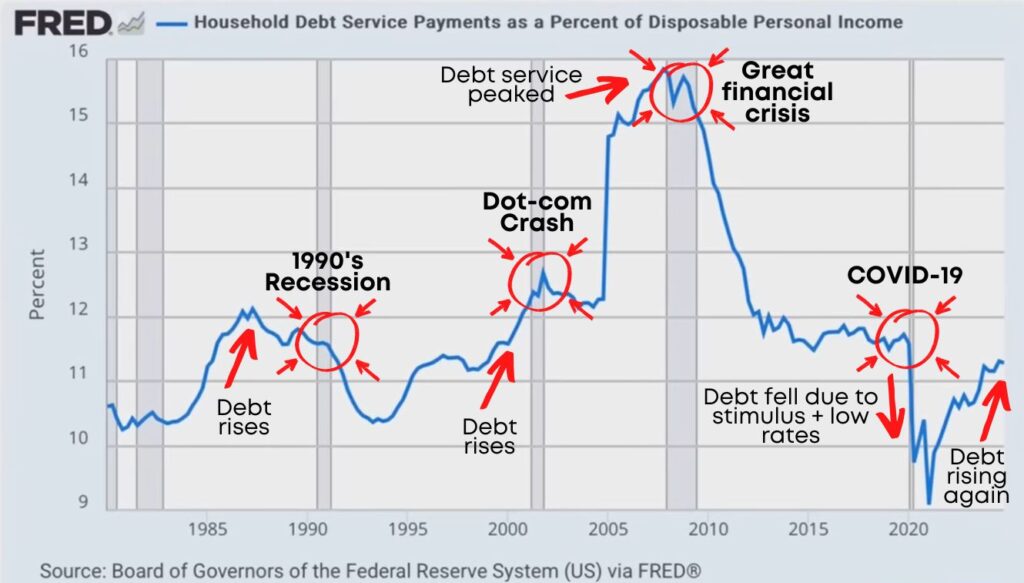
Notice what happens before major economic stress:
Debt payments rise steadily… households stretch… then the system cracks.
We saw it in the 1990s recession.
We saw it before the 2008 crisis.
And today, debt payments are rising again after historic lows.
Why higher interest rates make the illusion worse
Here’s the part most people miss:
When interest rates rise, debt becomes more expensive, even if your lifestyle doesn’t change.
Car loans cost more.
Credit card interest costs more.
Student loan rates rise.
Business borrowing costs more.
So even if you’re “doing the same things,” you can end up paying more… just to maintain your current life.
That is how people slowly drift into:
Carrying balances longer
Making only minimum payments
Living paycheck-to-paycheck while still “appearing fine”
The cycle that creates debt-driven booms (and debt-driven busts)
Here’s the simplest way I can explain the modern debt cycle:
1. Cheap debt: Interest rates are low. Borrowing feels painless.
2. More borrowing: More people finance cars, homes, renovations, vacations, tuition, lifestyle upgrades.
3. More spending: More spending boosts the economy. Stocks rally. Confidence rises. Everyone feels richer.
4. Payments become a problem: Rates rise or life changes. Income uncertainty increases. Debt payments feel heavier.
5. Spending slows: People cut “optional” spending (travel, restaurants, upgrades). They prioritize debt payments.
6. The economy slows: Debt-driven booms can flip into debt-driven busts.
Key takeaway: A debt-driven boom can’t last forever. Eventually, the payments show up.
Housing debt vs. everything else
Most people assume the biggest debt problem is housing, because a mortgage is usually the largest bill.
Housing debt matters. A lot.
But what’s increasingly dangerous is non-housing debt.
Especially because it tends to be higher interest, more flexible, and easier to accumulate quietly.
Non-housing debt includes:
Auto loans
Student loans
Credit card debt
Personal loans
The real warning signal: delinquencies
Debt alone isn’t the only issue.
The issue is: Are people actually able to pay it?
A key stress indicator is 90+ day delinquency.
In plain English: You’re three months behind.
When delinquencies rise, it usually means something is breaking in the household budget:
Income loss
Hours cut
Inflation pressure
Payments are too high
Debt is stacked too deeply
The categories that tend to flash first are:
Credit cards
Auto loans
Other consumer debt
Mortgages look more stable than 2008 (important difference), but consumer debt stress matters because it hits spending behavior fast.
Credit card stress doesn’t stay isolated. It spreads into the real economy.
What this means for you
People can keep spending for a while.
Especially when they’re using credit.
That can make the economy look “fine” on the surface.
But if it’s powered by debt, it’s not stable. It’s borrowed time.
When more of your income goes to debt, you lose options:
You save less
You invest less
You take fewer risks in your career
You feel more anxiety about small emergencies
“Debt + falling savings” is a yellow caution light.
Not guaranteed recession.
But a signal that households are less resilient than they appear.
Wage growth vs. inflation: why it still feels tight
You can have periods where wages “outpace inflation”…and still feel broke.
Why?
Because headline inflation is an average.
Your actual budget is dominated by categories that often inflate faster:
Rent / housing costs
Groceries
Insurance
Childcare
Transportation
So even if the chart says “wages are up,” your lived experience can still be:
“My money doesn’t stretch like it used to.”
That’s because inflation erodes purchasing power over time, and the stuff you buy most often tends to be the stuff that hurts the most.
The 3-level plan to protect yourself in a Debt Mirage economy
If the economy is fragile, your job is not to panic.
Your job is to become financially unbreakable.
Here’s the framework I use:
Level 1: Reduce Financial Fragility
First, check your Debt-to-Income (DTI) ratio.
This shows how much of your monthly income goes toward debt payments.
Formula: Monthly debt payments ÷ monthly gross income
Include credit cards, auto loans, student loans, personal loans, and housing.
Targets:
Under 20% → Strong
20–35% → Manageable but vulnerable
36–50% → High risk
50%+ → Financially fragile
The higher your DTI, the less flexibility you have if income drops.
Level 2: Defense
Pay off high-interest debt (credit cards, payday-style loans, personal loans)
Cut wasteful spending you don’t value
Create a simple budget you can stick to
Build a 3–6 month emergency fund
Lock down essential insurance coverage (health, disability, life if needed)
Level 3: Offense
Invest consistently (even through volatility)
Increase income (side income, skill upgrades, career leverage)
Build passive income over time (dividend income, rental income, interest income)
This is how you stop being reactive to the economy and start being positioned for it.
The 4-question checklist
If you do nothing else, ask yourself:
Do I have high-interest debt right now?
Do I have a 6-month emergency fund stashed in a HYSA (high yield savings account)?
Am I investing consistently, no matter what the market is doing?
Do I have more than one income stream or a plan to increase income?
If you answered “No” to any of these questions, you know where to start.
The bottom line
The Debt Mirage is simple:
The economy can look strong when people are spending, even if that spending is all debt.
But the bill always comes due.
Your goal is not to predict the next recession.
Your goal is to make your household financially unshakeable, whether it comes or not.
That is how you opt out of the illusion and build real wealth.
Start today.
Your bank account will thank you later,
Fiona
The Millennial Money Woman