
What does a $326,000 investing mistake look like?
Panic selling during a market crash to “feel safe.”
I watched it happen in 2008…
Two investors. Same portfolios. Opposite decisions.
One sold everything. One stayed invested.
The difference 11 years later? $326,000.
Here’s exactly how it happened (and how you can avoid making the same mistake):
Investor A: The Market Timer
March 2008:
- Portfolio value: $250,000
- Watching the news every night
- Anxiety building as markets decline
October 2008:
- Market down 35% from peak
- Portfolio now worth $162,500
- Can’t take it anymore – sells everything to “stop the bleeding”
- Plans to “get back in when things stabilize”
March 2009:
- Market starts recovering
- Waits for “confirmation it’s safe”
- Misses the initial 20% rebound
June 2009:
- Finally reinvests at higher prices
- Has $162,500 to invest (the cash from selling)
December 2019 (11 years later):
- Final portfolio value: $486,000
- Return: ~10% annualized from reinvestment point
The cost of panic selling and market timing: Over $300,000
Investor B: The Long-Term Investor
March 2008:
- Portfolio value: $250,000
- Also watching the news, also anxious
October 2008:
- Portfolio down to $162,500
- Painful to watch, but does nothing
- Actually continues monthly $500 contributions
March 2009:
- Still fully invested
- Buying shares at historically low prices with monthly contributions
December 2019 (11 years later):
- Final portfolio value: $812,000
- Return: ~10.5% annualized on original investment, plus new contributions compounded
The reward for staying invested: $326,000 more than Investor A
Same starting point.
Same market conditions.
Completely different outcomes.
The only difference? Investor B stayed invested through the volatility.
The Data Backs This Up
Take a look at this chart showing S&P 500 returns from 1990-2019:
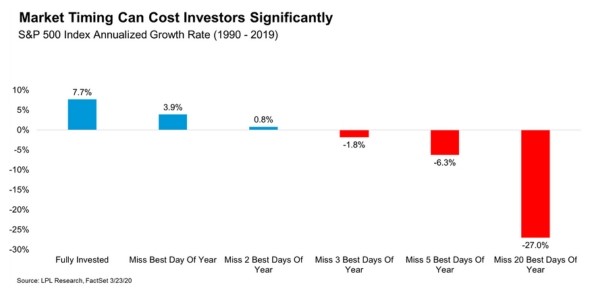
Here’s what it shows:
- Fully Invested: 7.7% annual return
- Miss the BEST 1 day: 3.9% annual return
- Miss the BEST 5 days: -1.8% annual return
- Miss the BEST 20 days: -27.0% annual return
Missing just the 5 best trading days over 30 years means the difference between growing your wealth and losing money.
Here’s the problem: Those best days are impossible to predict.
In fact, many of the market’s best days happen during the most volatile periods – right when investors are most tempted to sell.
During the 2008-2009 crisis:
- 6 of the 10 best single-day gains happened within 2 weeks of the 10 worst days
- If you sold to “avoid the bad days,” you almost certainly missed the best days too
You can’t have one without risking the other.
What Investor B Did Differently (And What You Can Do)
Investor B didn’t have superhuman discipline.
She had a system that removed emotion from the equation.
Here’s her exact strategy:
1. Automated Everything
- Set up automatic monthly contributions ($500) to her investment account
- Enabled automatic dividend reinvestment (DRIP)
- Never had to “decide” to invest – it just happened
Why this works: You can’t panic sell or time the market if your investing is on autopilot.
2. Stopped Checking Daily
- Deleted investing apps from her phone
- Checked portfolio quarterly instead of daily
- Focused on account statements showing contributions, not daily fluctuations
Why this works: Daily volatility triggers emotional reactions. Quarterly reviews show the long-term trend.
3. Had a Written Investment Plan
Before the crisis, she wrote down:
- “I’m investing for retirement in 25+ years”
- “Short-term volatility is expected and normal”
- “I will not sell unless my financial goals fundamentally change”
During the crisis, she reread this document weekly.
Why this works: Your future self makes better decisions than your panicked present self.
4. Used the “STOP” Technique
Whenever she felt the urge to sell, she asked herself one question:
“Has my financial situation fundamentally changed, or is this just market noise?”
99% of the time, the answer was noise.
Why this works: Verbalizing your thoughts interrupts the emotional response and engages rational thinking.
5. Asked Three Key Questions
Before any buy or sell decision, she asked herself:
- Do I believe in the long-term potential of these investments? (Yes – diversified index funds in profitable companies)
- Am I investing for a long-term goal? (Yes – retirement in 25+ years)
- Has my financial situation fundamentally changed? (No – still employed, emergency fund intact)
If all three answers supported staying invested, she did nothing.
Why this works: Creates a logical framework that overrides fear-based decisions.
The Bottom Line
Investor A tried to outsmart the market.
Investor B trusted time in the market.
The result?
Investor B ended with $326,000 more.
Here’s what I learned from advising hundreds of investors:
The ones who built the most wealth weren’t the smartest.
They weren’t the ones with the best market predictions.
They were the ones who:
- Invested consistently, regardless of market conditions
- Stayed invested through volatility
- Automated their investing to remove emotion
- Focused on decades, not days
The hardest part of successful investing isn’t finding the right stocks.
It’s doing nothing when everyone else is panicking.
Investor B’s $326,000 advantage came from having a system that helped her do exactly that.
Build your system today.
Your bank account will thank you later,
Fiona
The Millennial Money Woman